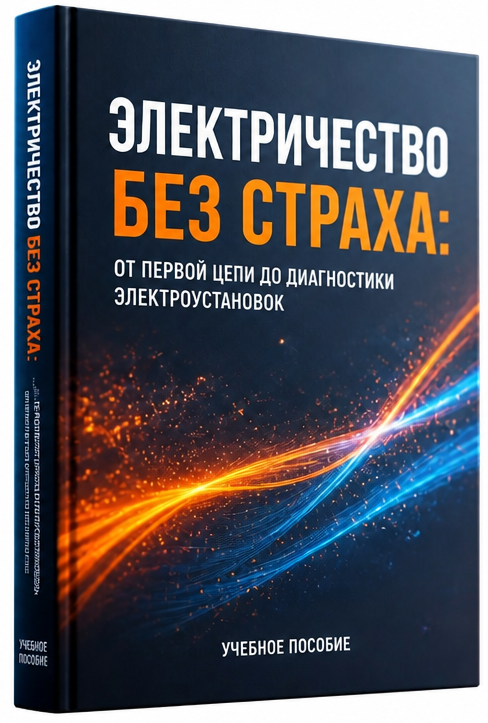
Электричество без страха: от первой цепи до диагностики электроустановок
Electricity rarely warns of its danger. It has no colour, no smell, and no visible movement. A wire that looks no different from its neighbour may be part of a working circuit, a protective system, or a hazardous section of an electrical installation. A disconnected device may still hold an electrical charge, and an outwardly sound connection may hide a poor contact, overheating, or insulation failure.
That is why electrical engineering does not begin with memorising formulas. It begins with understanding how an electrical circuit is arranged, where the energy comes from, what path the current takes, what happens during a fault, and how to safely verify your assumptions.
This training manual is designed for the initial training of future electricians, students of vocational and secondary specialised education, beginners, and teachers of electrical disciplines. Its content is structured as a gradual progression from a safe training circuit to understanding electrical installations, protective devices, electrical machines, and fault-finding methods.
The core idea of the book:
A good electrician does not guess the fault. He understands the physics, reads the diagram, measures, and only then draws a conclusion.
The book systematically covers:
Safety — safe work permit procedure, absence of voltage verification, capacitor handling, DC sources, personal protective equipment.
Fundamentals of electrical circuits — electric charge, current, voltage, resistance, Ohm´s law, power and energy, AC and DC.
Circuit connections — series, parallel, and mixed circuits, Kirchhoff´s laws, capacitors and inductors.
Measurements and electrical installations — multimeter and electrical measurements, conductors, cables and connections, line, neutral and protective conductors, earthing systems (TN-C, TN-S, TN-C-S, TT).
Protective devices — circuit breakers, fuses, RCDs, RCBOs, motor protection.
Electromagnetism and electric drives — magnetic field, electromagnetic induction, transformers, electric motors (DC, AC induction), variable frequency drives.
Professional work and diagnostics — reading electrical diagrams, fault diagnostics, professional techniques, the "five whys" method, fault-finding algorithm.
Each chapter includes definitions, examples, formulas, tables, algorithms, practical tasks, self-assessment questions, and case studies. The appendices contain basic electrical quantities, a diagnostic algorithm, a glossary of terms, and a self-assessment card.
The manual is useful for students of technical disciplines, trainee electricians, power engineers, teachers, and anyone who wants to master electrical engineering from scratch — from a safe circuit to professional electrical installation diagnostics.
Section I. Electricity and Safety
Chapter 1. Safe start of any work — energy sources, safe work permit procedure, absence of voltage verification, capacitor handling, PPE, typical errors.
Chapter 2. What happens during electric shock — influencing factors, current path, AC and DC, electric arc, humidity, neutral conductor hazard, first aid.
Chapter 3. The first training circuit — source, conductors, load, switch, protection, circuit assembly, first switch-on, voltage measurement.
Section II. Fundamentals of Electrical Circuits
Chapter 4. Electric charge, current, voltage and resistance — charge, current, voltage, resistance, Ohm´s law, measuring instruments.
Chapter 5. Electric power and energy — work and energy, power, rated vs actual power, AC, power factor, efficiency.
Chapter 6. Direct and alternating current — DC, AC, period, frequency, peak and RMS values, single-phase and three-phase systems.
Chapter 7. Series, parallel and mixed circuits — series connection, parallel connection, mixed circuits, Kirchhoff´s laws, short circuit.
Chapter 8. Capacitor and inductor — capacitor, capacitor energy, residual voltage, inductor, self-induction, coil protection, RLC circuits.
Section III. Measurements and Electrical Installations
Chapter 9. Multimeter and electrical measurements — multimeter construction, categories, voltage, current, resistance measurement, continuity, clamp meters.
Chapter 10. Conductors, cables and electrical connections — wire, core, cable, conductor material, cross-section, heating, voltage drop, connections, terminals, marking.
Chapter 11. Line, neutral and protective conductors — L, N, PE, PEN, earthing systems (TN-C, TN-S, TN-C-S, TT), neutral break, marking.
Chapter 12. Protective devices — overload, short circuit, fuse, circuit breaker, RCD, RCBO, motor protection, selectivity.
Chapter 13. Ohm´s law and calculations for electricians — current, power, energy, conductor resistance, voltage drop, series and parallel circuits, three-phase power.
Section IV. Electromagnetism and Electric Drives
Chapter 14. Magnetic field and electromagnetic induction — magnetic field of a conductor, coil, electromagnet, force on a conductor, Faraday´s law, Lenz´s law, generator, motor, relay.
Chapter 15. Transformer — construction, transformation ratio, winding currents, no-load operation, losses, saturation, safety transformer, autotransformer, current transformer.
Chapter 16. Electric motors — stator and rotor, DC motor, induction motor, synchronous speed, slip, starting current, heating, diagnostics.
Chapter 17. Electric drive — power and control circuits, direct-on-line starting, reversing, star-delta starting, soft starter, VFD, braking, diagnostics.
Section V. Professional Work and Diagnostics
Chapter 18. How to read electrical diagrams — diagram types, symbols, reading by levels, power and control circuits, ladder diagrams, fault finding using diagrams.
Chapter 19. Fault diagnostics — symptom and cause, fault history, visual inspection, hypotheses, measurement selection, circuit division method, motor and VFD diagnostics.
Chapter 20. Professional techniques for electricians — 16 professional techniques, the "five whys" method, diagnostic sheet, corrective and preventive actions.
Conclusion and Appendices
Basic electrical quantities (table).
Diagnostic algorithm.
Glossary of terms.
Self-assessment card.
Оплата и выдача товара осуществляются через партнёрскую платформу.